
The Fleet Efficiency Study
The Fleet Efficiency Study (previously known as the Fleet Fuel Study) is a deep-dive investigation into the adoption of various products and practices for improving freight efficiency among 29 major North American fleets. Fleets share with NACFE their purchase and use of 80+ technologies going back to 2003.
This is the 11th update of the North American Council for Freight Efficiency’s (NACFE) 2012 inaugural study that has been described as an important read for anyone working in this area. This report incorporates technology adoption and efficiency that now includes data from 2024 and 2025. For the first time in the history of this report, MPG data has been split by linehaul and regional-haul duty cycles.
The study provides real-world insight on what fleets are doing to get more miles from a gallon of diesel fuel and is based on the premise that regardless of the cost, fuel represents a significant portion of a fleet’s total operating costs.
Adoption Rates
The study draws on the fleets’ annual truck purchases from 2003 through 2025, recording the adoption rate for each of more than 80 currently available fuel-saving technologies. From this data, the report builds adoption curves for every technology, shows how adoption varies across fleets, and tracks the fleets’ average fuel economy over all 23 years.
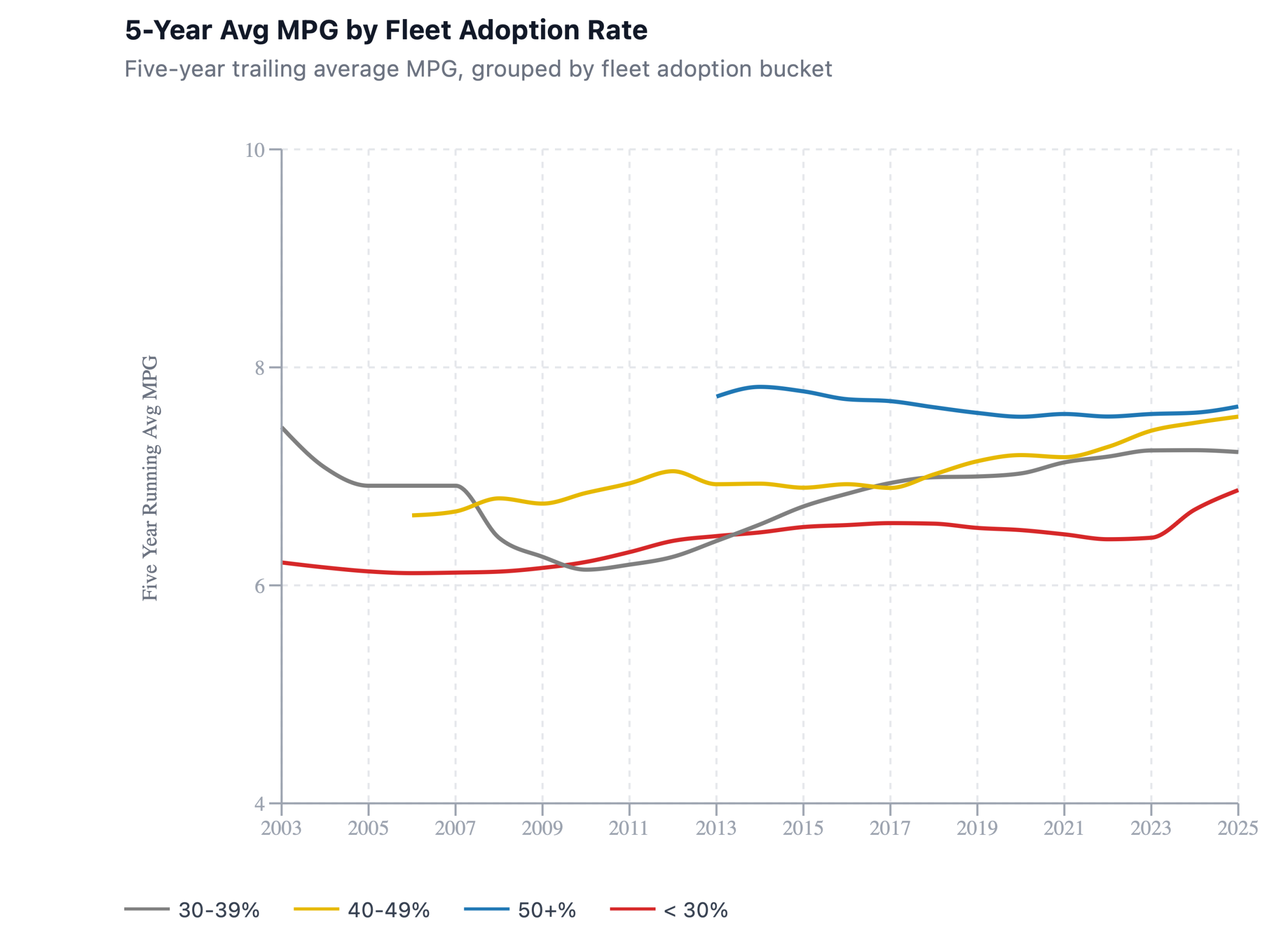
Higher adoption rates correlate to higher MPG throughout the 14 years for which NACFE has collected data. Fleets with the highest adoption rates consistently achieve the highest MPGs.
-
2026 Fleet Efficiency Study – Executive Summary November 2026
-
2026 Fleet Efficiency Study – Full Report November 2026
Fuel Savings
For 2025, the linehaul FES MPG reached an all-time high of 7.96 MPG while regional-haul MPG was 7.29 MPG. In 2010, fleets that we categorized as regional haul were 35% of the participants. In 2025, that number rose to 57%.
In 2024, at an average 7.4 MPG versus 7.1 MPG, the studied fleets were more profitable on every truck by $2,373 ($0.024/mile) because of reduced fuel cost versus the average combination truck in the US assuming 100,000 miles per year and the average cost of fuel in 2024. That gap has narrowed in recent years as the Federal Highway Administration number has increased very dramatically since 2019. At the current 2026 fuel prices, which are at a relative historic high, the savings were $3,520 [KE1] per truck. For the fleets that contributed data to the FES this year, across their respective fleets, this amounts to a savings of more than $200 million.
Interactive Online Tools for Fleets
Accompanying this report is the NACFE FES Technology Adoption Explorer, an interactive online tool. The Explorer lets readers investigate the data on their own terms. Users can filter by technology category and switch between linehaul and regional-haul fleets to see how adoption patterns differ by duty cycle and see how the speed of adoption among various technologies varies using the Trends view.
Technology Adoption Explorer
Benchmarking Tool
Users have the ability to complete their benchmarking online for each technology category in which they are interested or for all 86 technologies. They then receive a customized inter-active report which includes the user’s responses prioritized by the technologies that have the greatest gap between the user and the average of the FFS fleets.
By using the interactive tool, fleets also contribute to the growing database of technology adoption data. There is no cost to use this tool.
Conclusions
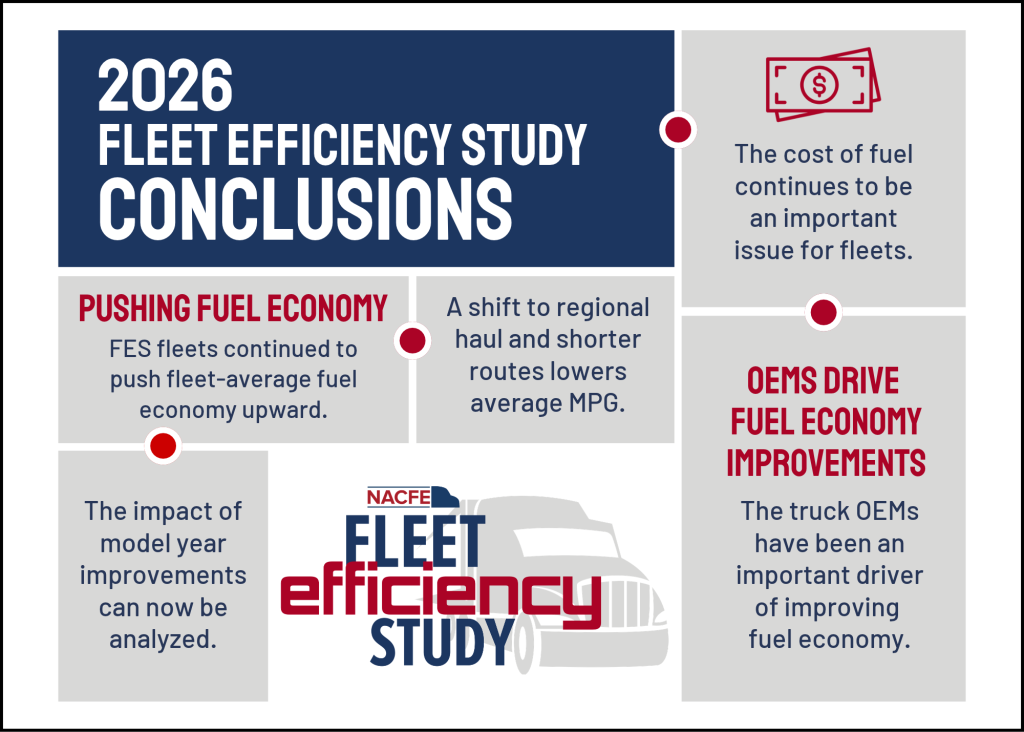
Following are the high-level conclusions reached by the study team this year.
- FES fleets continued to push fleet-average fuel economy upwards.
- A shift to regional haul and shorter routes lowers average MPG.
- The cost of fuel continues to be an important issue for fleets.
- The truck OEMs have been an important driver of improving fuel economy.
- The impact of model year improvements can now be analyzed.
Recommendations
In the last FFS, NACFE developed some recommendations for fleets that are evaluating fuel-efficiency technologies. Those recommendations are still valid today.
- Collect and monitor fuel consumption by vehicle.
- Commit to and budget for an ongoing plan of MPG improvement.
- If possible, develop a test route and test driver with which to test new technologies.
- If purchasing used equipment, purchase equipment from fleets known for having good fuel economy.
- Allow for failure.
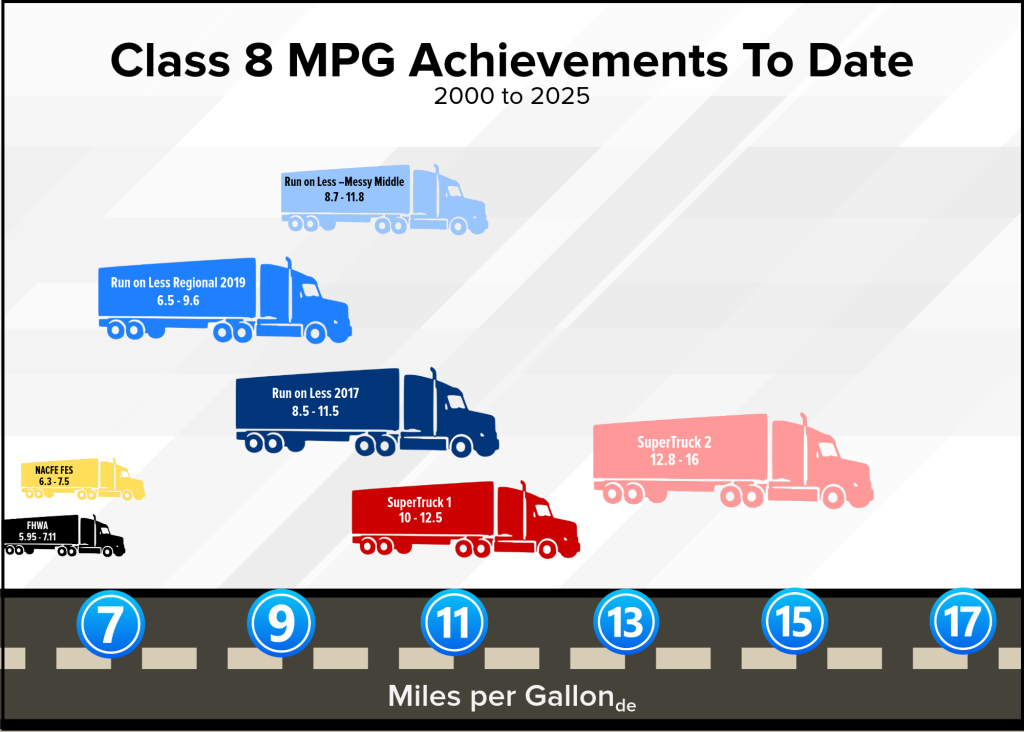
It is important for fleets to benchmark their MPG. There are a variety of benchmarks that can be used including average US Class 8 tractor-trailer MPG, FFS fleet-wide average, SuperTruck 1 and 2 trucks and trucks that participated in NACFE’s Run on Less demonstrations. Many of these numbers show just how far the MPG envelope can be pushed. While there has been great improvement in MPG and fleets, there is still room for more improvement as more fleets can adopt some of the technologies and practices covered in this report that boost MPG.
Previous Fleet Efficiency Study Reports
NACFE conducted the first Fleet Efficiency Study (then called the Fleet Fuel Study) in 2012. It was conducted annually from 2012 to 2018. Beginning in 2020, the study was conducted every other year. Each report includes technology adoption information back to 2003. It also includes adoption curves for the various technologies and practices in which fleets are investing.
Below are copies of all prior Fleet Efficiency Reports.
-
2024 Fleet Fuel Study December 2024
-
2022 Annual Fleet Fuel Study December 2022
-
2019 Annual Fleet Fuel Study January 2020
-
NACFE 2018 Annual Fleet Fuel Study August 2018
-
2017 Annual Fleet Fuel Study August 2017
-
NACFE 2016 Annual Fleet Fuel Study August 2016
-
NACFE 2015 Annual Fleet Fuel Study May 2015
-
NACFE 2014 Annual Fleet Fuel Study August 2014
-
NACFE 2013 Annual Fleet Fuel Study March 2013
-
NACFE 2012 Annual Fleet Fuel Study February 2012
